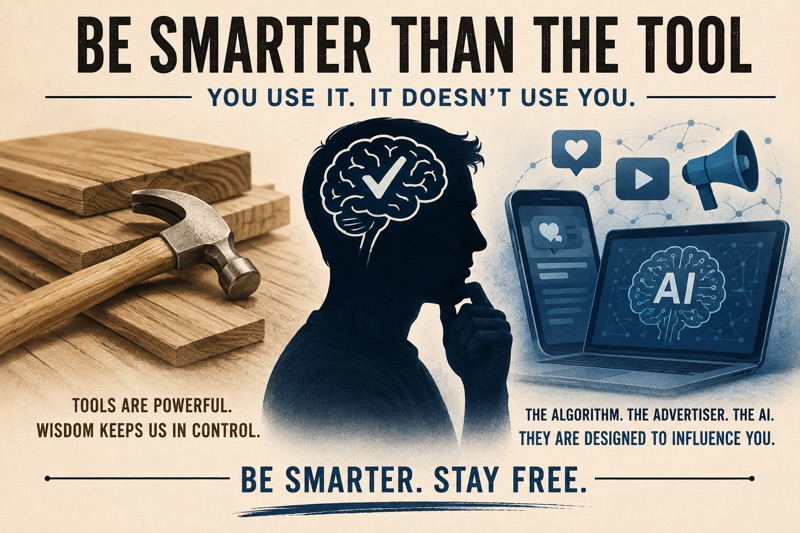
One of the best pieces of wisdom I ever received didn’t come from a college professor or a leadership seminar. It came Don Abernathy, a trim carpenter.
Whenever I got frustrated trying to fit a piece of trim, Don would grin and say,
“You just have to be smarter than the wood.”
At first, it sounded funny.
Over the years, I realized he wasn’t just talking about wood
He was talking about tools in general and a principle that is true across many areas of life.
A carpenter doesn’t force the wood to cooperate. He learns how it behaves. He understands its grain, its strengths, its weaknesses, and its limitations. The wood isn’t intelligent. BUT, if you’re careless, impatient, or unskilled, it can still beat you.
That simple statement has become a principle I’ve carried into almost every area of life.
You have to be smarter than the hammer.
You have to be smarter than the airplane.
You have to be smarter than the spreadsheet.
You have to be smarter than the chainsaw.
Every powerful tool requires a certain level of wisdom before it can safely be placed in your hands.
That’s why we don’t hand an infant a hammer.
We don’t let a six-year-old drive a car.
We don’t allow children to play with sharp knives.
We require years of education before someone can practice medicine, argue a case in court, or design a bridge.
The greater the power of the tool, the greater the responsibility of the user.
For centuries, society has recognized this principle.
Then came the internet.
The internet is perhaps the most powerful tool ever placed into the hands of ordinary people, yet almost no one receives formal training in how to use it wisely. There is no license. No competency test. No required education before entering a world specifically designed to capture your attention.
Instead, we simply hand everyone a smartphone.
Today, artificial intelligence raises the stakes even higher.
AI is an extraordinary tool.
It can summarize books, write code, analyze data, brainstorm ideas, generate images, and help solve problems in seconds that once took hours.
But here’s the danger.
If you’re not smarter than the AI, the AI begins thinking for you.
If you’re not smarter than the algorithm, the algorithm decides what you see.
If you’re not smarter than the advertiser, the advertiser determines what you want.
Eventually, you’re no longer using the tools.
The tools are using you.
Being “smarter than AI” doesn’t mean you know more facts than it does. That’s impossible.
It means you know things AI never can.
You know your values. You know your purpose. You know the difference between wisdom and information. You know when an answer is technically correct but morally wrong. You know when to question an output instead of accepting it.
AI has incredible intelligence but it has no judgment.
That still belongs to us.
In many ways, this is no different from every other technological leap in history. Fire can cook a meal or burn down a house. Electricity can power a hospital or an electric chair. Every invention amplifies the intentions of the person using it.
AI is simply the newest amplifier.
The real question isn’t whether AI is good or bad.
The real question is whether we are using it as a tool to become more wise.
As a Christian, I think Scripture has been preparing us for this long before the first computer was built.
“Test everything. Hold fast what is good.” Don’t believe every spirit. Seek wisdom. Renew your mind. Guard your heart.
Those commands assume that we will constantly encounter ideas competing for our attention. AI simply accelerates the speed and volume of those ideas.
So use AI. Use search engines. Use social media. Use every good tool available.
Just remember what Don taught me years ago in a dusty house.
“You just have to be smarter than the wood.”
The same is true today.
Be smarter than the algorithm.
Be smarter than the advertiser.
Be smarter than the AI.
Because the moment you’re not…
the tool has become your master.


 Posts
Posts