Tuesday, March 31, 2026

Palm Sunday: A Tale of Two Kings


A Tale of Two Kings: The King We Want vs. The King We Need

I’ve always found it difficult to think about Palm Sunday without first thinking about David’s conquest of Jerusalem in 2 Samuel 5.

That may seem like a strange place to begin when the church calendar is focused on palm branches and Hosanna, but years ago I heard Sandy Wilson briefly connect those two stories, and ever since then I haven’t been able to separate them in my mind.

In many ways, Palm Sunday really is a tale of two kings.

David was the king the people had always wanted. He was strong, decisive, victorious, and powerful. Jerusalem sat high and fortified, never having been conquered, and the Jebusites mocked him by saying that even “the blind and the lame” could defend it. But David found a weakness, entered through the water structure, and took the city. It became the city of David, the political and symbolic center of Israel’s power.

This is what the people had long desired — a king who could conquer, establish greatness, and make them significant among the nations.

And that desire did not begin with David.

Back in 1 Samuel 8, the people had asked for a king “like the other nations.” God’s response was clear: in asking for a king, they were rejecting Him as their King. Yet He allowed them to have what they wanted.

That desire for a visible, powerful, earthly king was deeply ingrained in the hearts of God’s people.

So when Jesus entered Jerusalem on Palm Sunday, it is no surprise that the crowd interpreted the moment through the lens of David.

Everything about the scene looked royal. The crowds gathered. The city was stirred. People lined the streets.

And yet, from the very beginning, something was different.

He came riding on a donkey. No army. No weapons. No war horse. No visible plan to overthrow Rome. The whole scene had the appearance of triumph, but it was a very different kind of triumph.

The people’s expectations, however, were unmistakable. They cried out, “Hosanna.”

That word is often heard as praise, but it is actually a cry for help: “Save us now.” And what they meant by that was not hard to discern.

Save us from Rome. Restore David’s kingdom. Make us a great nation again. Give us back our significance. Be our next David.

They were not praising Jesus. They were defining their expectations of him.

This is where Palm Sunday becomes deeply personal for us. The people were not confused just once. They misunderstood consistently.

Even the disciples, who had walked with Jesus and heard Him repeatedly say that He would suffer, be rejected, and die, somehow still held onto the expectation that He was about to establish a political kingdom in Jerusalem.

Their expectations were so strong that even clear truth could not break through.

They had a severe case of expectation blindness. And if we are honest, it is not just their problem. It is ours as well.

Scripture warns us that it is entirely possible to know the Bible, follow Jesus, and still miss Him because our expectations are louder than His words.

We all have expectations of what God should do. We assume He should solve the problem in front of us. We assume He should remove our suffering. We assume He should restore what we think has been lost.

And sometimes, when He does not do those things, we begin to question whether He is really at work.

But Palm Sunday reminds us that Jesus often refuses to meet our expectations because He is after something deeper.

The crowd wanted Him to march toward Rome. Instead, He marched to the temple. He drove out corruption. He confronted the heart of their broken worship.

And then, in one of the most beautiful contrasts in all of Scripture, the very people who had been pushed to the margins in David’s story (2Sam5:8) — the blind and the lame — were welcomed and healed by Jesus in the temple.

David took the city. Jesus came to redeem it. Not just the city. The world.

That is the King we needed.

On Palm Sunday, the crowd welcomed Him like a conquering king, not realizing that His victory — and theirs — would come not through a crown, but through a cross.

The King they needed had to die, not reign.

And that remains true for us.

We are still prone to creating a god in our own image, a version of God that feels manageable, familiar, and predictable. We want a king who exists to meet our needs, solve our problems, and validate our expectations.

But sometimes the very thing we are asking God to remove is the thing He is using to transform us.

As James 1 reminds us, trials produce endurance, maturity, and wholeness. So when Jesus does not meet our expectations, it does not mean He is failing us. More often than not, He is forming us.

That is why Palm Sunday leaves us with a question we all must answer:

Do we want the King we have imagined?

Or do we trust the King who actually came?


Thursday, February 12, 2026

When the burden is heavy

Ever spend a night wrestling with sleep—your mind running laps around a big decision, a looming deadline, or an unbelievable pile-up of life events?


Yeah. Me too.


Jesus once said, “Do not worry about your life—what you will eat or what you will drink; nor about your body, what you will put on.” That feels almost unrealistic in a world like ours. Not because we don’t believe Him—but because we are absolutely drowning in information.


The modern problem isn’t scarcity of knowledge. It’s overload.


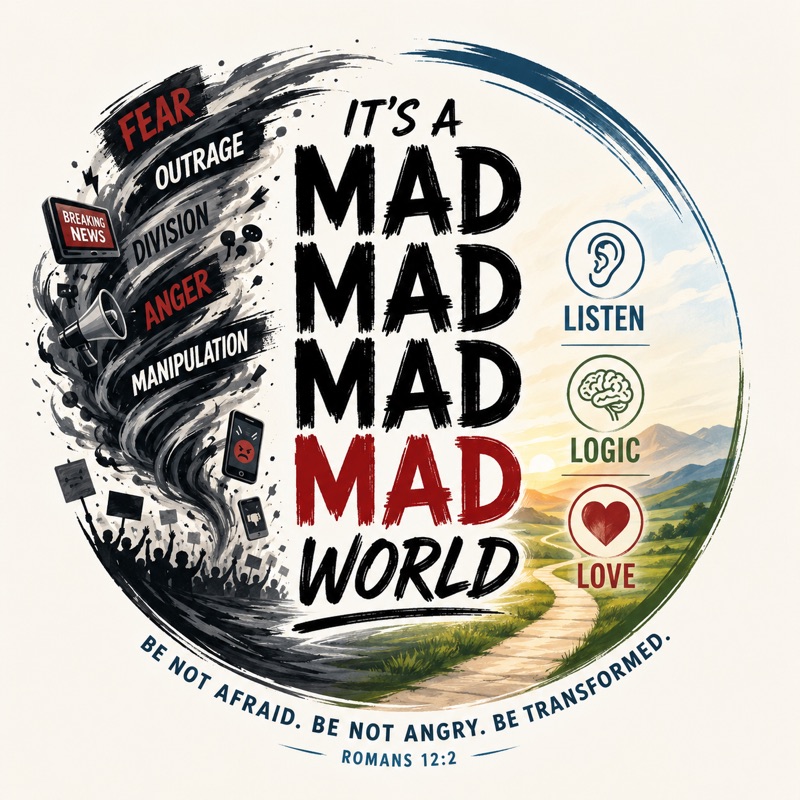
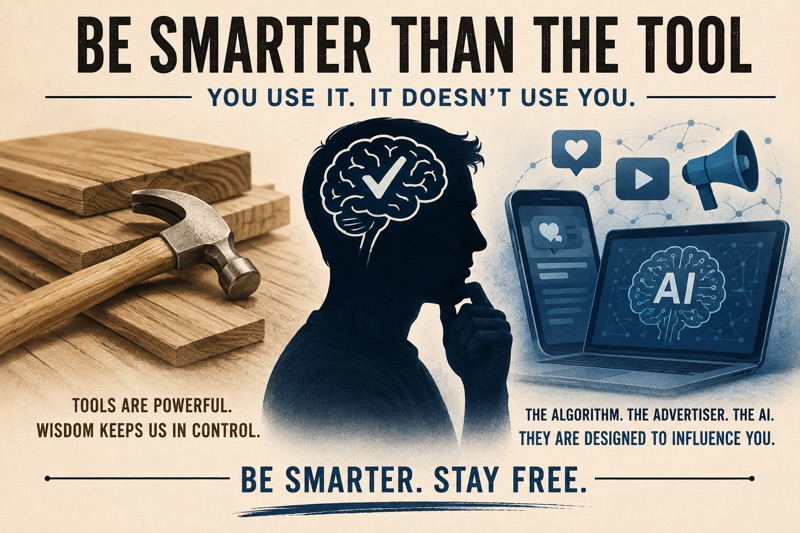
We are exposed to more opinions, warnings, predictions, and “urgent” threats in a single day than most people in history encountered in a lifetime. Everyone has a megaphone. Everyone is telling us what the next great danger is. Everyone wants us alert, anxious, and ready to react.


And slowly—almost imperceptibly—we begin worrying about things far beyond our daily needs. We carry concerns we can’t control, outcomes we can’t influence, and futures we were never meant to manage.


At some point, something has to give.


At some point, we have to say: enough is enough.


I’m going to identify what I actually need to focus on today—and I’m going to dismiss the rest. I’m going to steward what’s in front of me, not everything screaming for my attention. And even more importantly, I’m going to place my trust where it belongs.


In the One who actually has control.

In the One who supplies daily bread.

In the One who sees every detail and is fully able.


Jesus didn’t say that needs don’t matter. He said worry doesn’t help. It doesn’t add a single hour to our lives. It only steals peace from the hours we already have.


There’s a quiet freedom in letting God carry what only God can carry.


And when we do?


“You will lie down and your sleep will be sweet.”


That promise still holds.


Tuesday, January 13, 2026

Thou shalt not bear false witness!

Most people remember the Duke Lacrosse team for perpetrating horrible acts against a young woman. They were suspended from the university, publicly shamed, stripped of their reputations, and treated as criminals before a trial ever reached a courtroom. Their lives were effectively ruined.

Yes, most people who were alive at the time remember that version of the story. And most people who are alive today still assume their guilt.

They were innocent.

Framed from the start.

False witness tattooed a stain on them that has lasted far longer in public memory than their vindication ever did.

Why is that? Why do so many people still remember them as guilty? I don’t think the answer is simply that the media under-publicized their innocence. I think it runs deeper than that.

My dad and I recently watched the documentary The Devil Next Door about the accused Nazi war criminal John Demjanjuk—known in the 1980s as “Ivan the Terrible.” His trial drew out dozens of witnesses, many of whom stood and testified falsely with absolute certainty that he was the man who committed unspeakable atrocities.

At one point my dad asked, “How could they just stand up there and lie with such passion and resolve?”

It was the perfect question.

My first-blush response was this: their hunger for justice was so intense that they needed their testimony to be true—and eventually it became true to them. Their desire for justice reshaped memory, emotion, and conviction until sincerity replaced accuracy.

The same thing happened in the Duke Lacrosse case. People’s hunger for justice for the “victim” permanently branded guilt onto the accused, regardless of the facts.

One of the Ten Commandments—often treated as one of the “lesser” ones—is this: You shall not bear false witness against your neighbor. I believe there are two forces in our culture that make this commandment not minor at all, but one of the most grievous.

The first is social media. False witness now has more power than it has at any point in human history. Everyone has access to everyone. Accusation travels faster than truth, and retraction travels nowhere.

The second is victim identity. We live in a culture that increasingly defines itself by whatever oppression that has been perpetrated upon us. We are victims of systems, structures, ideologies, institutions, traditions—real or perceived. Victimhood now carries moral authority, and moral authority often silences scrutiny and overrides truth.

If you doubt that, ask why questioning an accusation or speaking out against an ideology is now treated as an act of hate.

When you combine social media, victim identity, and humanity’s natural thirst for justice, you create the perfect breeding ground for the devastation of false witness. “Believe the accuser” has become the rallying cry of the age and that is a deadly mantra.

How many of you know people who have been falsely accused by an ex-spouse, an ex-employee, or a former friend?

We should all have our hands raised.

False accusation is so common that it made the Big Ten. It is so common that the justice system in the free world was deliberately designed to assume innocence and demand proof beyond a reasonable doubt from twelve people who must be convinced together.

What’s my point?

Our culture needs to be reminded of this. And we need to remind ourselves. Bearing false witness is devastating.

We have witnessed enough false accusations in our lifetimes to know that not everything we read—especially online—is true. Much of it is not just an innocent mistake, but deliberately false.

Test the spirits. Understand human nature. Don’t rush to judgment. Don’t let your desire for justice override your commitment to truth.

Justice is coming. It's coming for us all!


Thursday, January 1, 2026

2025 in the Rear-view Mirror

The older I get, the more each year feels less like a calendar box and more like another chapter God is writing — one I couldn’t write myself if I tried. And if 2025 taught me anything, it’s that joy and sorrow really can walk side-by-side when the Lord is the One holding both. Now that I’ve got this year in the rear-view mirror, I can see just how much living and how much grace He fit into twelve months.

This was the year we lost Poppy — my father-in-law and one of the steady men in our lives. It’s hard to capture a man like him in words that feel big enough. He was consistent. He was present. He loved quietly and deeply and didn’t make life about himself. He adored his family with a warmth that felt like home. We grieve because he mattered. Yet Scripture reminds us that we “do not grieve as others do who have no hope” (1 Thessalonians 4:13). Christ’s resurrection really does change what a graveside feels like. We said goodbye but one day the ache will give way to reunion. Until then, we thank God for the gift of his life and the mark he left on ours.


And while grief was finding its way into our days, joy found a seat at the same table. I had the privilege of watching Jay become a husband. Emma didn’t just marry into our family — she became part of our hearts. “Every good and perfect gift is from above” (James 1:17), and these gifts felt especially tender this year.


At the same time, God was leading me through one of the hardest decisions of my adult life — stepping down from my staff role and eldership at Harvest DeSoto, and ultimately from a church body I had served for eighteen years. You don’t spend nearly two decades praying, preaching, loving, crying, counseling, worshiping, and carrying burdens with a people without your heart becoming woven into the fabric of that place. Leaving wasn’t about losing belief in the mission. It was obedience to the God who cares more for my soul than He does for my usefulness. I needed restoration more than I needed a role — even when I didn’t know how much.


I’d love to say I handled all of this with peace and composure, but the truth is my body finally rang the alarm. The stress caught up with me and landed me in the ER — and because humility needs humor, I wound up back there again after slipping on a pineapple. Some lessons you learn spiritually. Others come with paperwork, an IV, and my wife’s eyes telling me enough is enough. 

This was also the year I hugged my Josie and left her at university. Pride and ache collided in a way only parents really understand. Watching her step into her calling reminded me again that our children belong first to the Lord — and He is faithful.

Louie grew and Sondra is the shortest member of the Hinton clan once again. He is navigating middle school well and is realizing his talents more each day. What a joy he is!


I also walked beside several dear friends as they buried parents, grandparents and loved ones this year. Standing near fresh soil never gets easier, but it does make the resurrection mean more. “Blessed are those who mourn, for they shall be comforted” (Matthew 5:4). And I watched the Holy Spirit do just that.


And yet, even with so much in motion, God kept certain things beautifully steady. My wife, faithfully loving and serving our family in a way the world rarely sees. My love for my family deepening, not fading. Friends who stayed close. A job of significance and value! Thank you, MW!!  And above all, the unwavering, stubborn faithfulness of God. “The steadfast love of the Lord never ceases; His mercies never come to an end; they are new every morning” (Lamentations 3:22-23). That verse wasn’t theory this year. It was oxygen.

Of course, God also slipped joy into the cracks. I gained a daughter-in-law. I learned I’d be a grandfather. I harvested the best deer I’ve ever taken. I went to see Dan Huff with my faithful friend Brian Edwards, a night that somehow combined music, gratitude, and worship. And I caught my first triple tails and found out what fish can really taste like.  Thanks, Johnny M!


So when I look back at 2025, I see loss and life, grief and gratitude, letting go and gaining, hospitals and pineapples, tears and laughter, and a God who did not once step away. “Even to your old age and gray hairs I am He, I am He who will sustain you. I have made you and I will carry you” (Isaiah 46:4).


I don’t know what 2026 will hold.


But I know the One who will be there when it comes.


And that is enough!!